Permaculture for Tim!

Now that I have lived in Tim's home for about a year, I am trying to apply permaculture principles to a larger site design. I've had a chance to observe sun and wind patterns and feel a tiny bit more confident about what is possible for Tim's property. The easiest will be the front yard garden, which I will call Zone 1. In October 2016, we started gardening in the front yard - tilling up the lawn, laying down manure and straw, and clearing out blackberry roots (I wish I had a photo from "Before"!). Here is a photo from last winter:


Over  the past year I put in edibles & ornamental perennials (donated), annuals and one fig tree. There are power lines overhead most of the yard so I had to place it carefully. Also, I tried to choose plants according to Tim's taste, and always checked in beforehand. He gave me a lot of freedom. It's amazing how after a little soil building, and making do with many donated plants and seeds, the front yard became this:


So here is our starting point for thinking about a larger permaculture design for the property. While considering Tim's personality and likely maintenance habits and goals, it's important to honor all the human elements: the house/deck, fire pit, batting cage, mother-in-law apartment and power lines -- all Zone 0. Designing sensible access around all of these will be critical, and minimizing high maintenance areas means all cultivated areas in the front yard -including just outside the fence and a small street garden- will be Zone 1. Everything else will be Zone 2. Here is a rough map (based on Google Earth image):


In this map I tried to clearly mark all the human elements (Zone 0: purple) and pathways. I wanted to place all cultivated areas into Zone 1 (green) to keep them under the scope of ongoing maintenance. They need to be properly cared for before more can be introduced; the greatest challenge will be keeping invasive weeds under control in most of Zone 2 (white). For example the south facing fence line of Tim's property has a terrible English Ivy problem, and the north-west facing portions of Zone 2 have a Himalayan blackberry battle. Zone 2 also contains new plantings like elderberry, bay tree, western red cedar and limber pine that will need a little bit of maintenance and a watchful eye. Caring for Zone 2 is essentially invasive weed management so that new plantings will be okay.

Now just for fun, here is the map again, this time with sectors depicted (sectors are external energies that move through land and influence how things grow, like wind and sun). I was recently introduced to a neat resource that helps you calculate the angles of sun where you live. In my first year of living here I wasn't sure what to expect and thought I may be living in a part-sun valley, so I didn't grow many heat-loving plants. I eventually observed that a portion of the yard receives full sun. To be honest I'm still not sure how to interpret the sun angles in this map, except to notice that the sun covers more of an area in the summer. Depicted here are the angles of summer sun (red) and winter sun (blue). I also included a fire sector around the fire put, thinking that plants shouldn't be placed around there for the sake of bonfires. I wasn't sure how to depict wind, though. I also added lines depicting where power lines go (unfortunately they're all basically in the front yard).


Now, I want to discuss the Zone 1 elements more in depth - they are all within the front yard fence line and the first thing people see when they visit the home. (Note: there is a small street-level garden, which should really be placed in Zone 2 because of it's proximity to the house, however, since it is already cultivated I will consider it in Zone 1.)

Zone 1: raised bed of greens; berry border; Fig Tree Guild, herb border

Raised Bed O' Greens
Characteristics: accessible to kitchen and close to spigot, consumed daily, high value
Needs: Nutrition, water, sun, hygiene, pest/disease management
Products: daily food for humans and insects, soil stabilization, beauty, multiple levels for growing plants in symbiosis (particularly the kale along the fence line)


Comments: the kale along the fence is starting to get tall, so I sowed cover crop (white clover) underneath for overwintering, and next spring other greens can be sown underneath. In the densely planted square bed, if we get many cold nights we might lose some of them (the mustard is getting stressed) but there's a great chance it will overwinter and stabilize the soil. In the spring we can cut much of it down, add some top soil and grow something else from another family. Before it was greens it was garlic. I'll have to see what Tim would enjoy there. 

Berry Border
Characteristics: several kinds of berries: raspberries, goji berries, strawberries, blueberry; high value perennials, food for humans and animals, high shrub and groundcover, in full sun year round, must compete with invasive himalayan blackberry.
Needs: acidic soil, lots of sun and water for berry production, nutrition, weed management, pruning
Products: delicious berries, seasonal interest (flowers and fall color), long term value, soil stabilization


Comments: the plants are all still babies and have many weeds to compete with, which luckily are all herbacious. Hopefully their roots will establish over the fall/winter so they will push a lot of new growth in the spring. The soil is more sandy in this area of the yard and suffers from some erosion, so continuing to add good top soil will be important. It's a big mystery as to how they will look in their second year!

Fig Tree Guild (Ficus carica 'Olympian')
Characteristics: baby fig tree planted, and some of the guild members are already present, as the tree gets larger with each passing year more members will be able to be added in. My dream is to have the whole front yard be a Fig Tree Guild.
Needs: good soil, sun, water, companion plants, weed management, training/pruning (not yet)
Products: summer shade, mulch, beauty, food, and it will be the one and only tree in the yard!
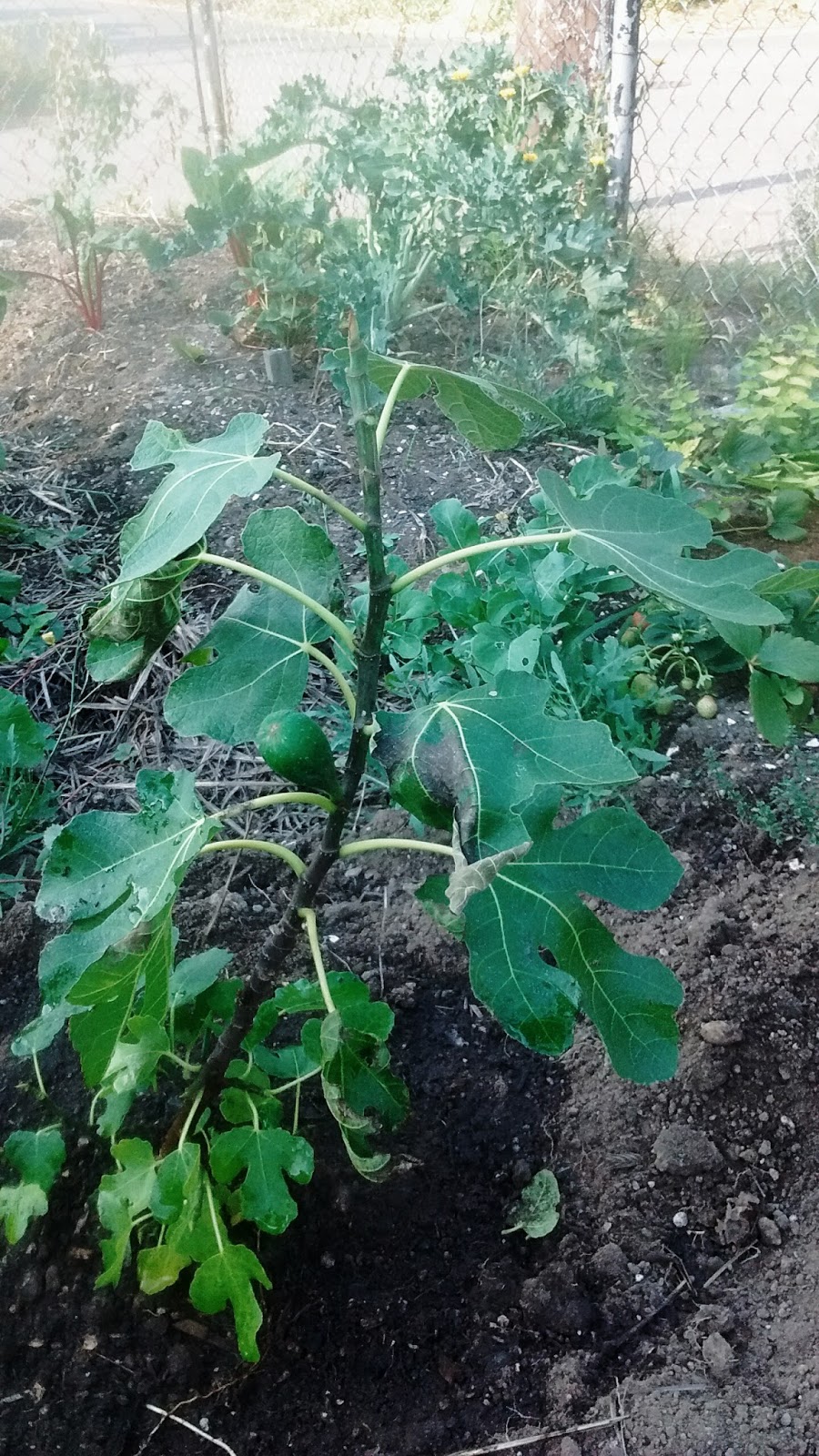

Comments: although figs grow faster than many fruit trees, it will be awhile before the guild really takes shape. A wonderful exercise in patience and also dedication. If we can set up the right environment from the get go, hopefully it will make it through it's first winter and be healthy! Stay tuned as more of this story unfolds with passing time.

Herb Border
Characteristics: In full sun, faster draining soil then inside the fence line; mostly perennial herbs and flowers that are drought tolerant; pleasing to the senses for pollinators and visitors, the first thing people see when they arrive! 
Needs: Pruning/ plant separation, nutrition, occasional summer irrigation
Products: Beauty, medicines, good smells, culinary purposes, gifts for friends and family


This is the photo from last year when it was first installed. Now below you an see what it looks like a year later!


Comments: this is my favorite area of the garden. There are so many textures, colors and smells all coexisting together. I am excited to see how all the plants evolve together in time. Also, I am hoping with the installation of vines and as the plants mature, the fence line will be obscured. 

In conclusion, I want to share my intentions for Year 2 on Tim's property. First of all, I wish to get the invasive weeds under control, and second, to appropriately maintain all the cultivated areas, while especially developing The Fig Guild. I am also not very clear on how wind moves through the property so will need to pay more attention to that too. Once Zone 2 is cleaned up and cleared out I can start thinking about cultivating other areas. Also -- given that the Fig is considered a Mediterranean plant, and because I believe I spent too much time/resources this past summer watering the garden, it would be best to transition the entire property toward more Mediterranean plants with minimal summer irrigation needs. Stay tuned!


Permaculture Ethics: Dealing With Consumption

I am a human being therefore it's highly possible that I cause pollution through my lifestyle. This is not something I want to admit or face because I would rather think of myself as good or wholesome, someone who is mitigating the pollution of my fellow species. But if I don't examine that in myself than I risk perpetuating toxic patterns. I remember going through this process before during a breakup, where suddenly all my shortcomings reared their ugly heads laughing at me and pointing fingers. Not the most fun. But I'm probably better for it now, having made some changes, and coming through to the other side.

I am trying to develop more awareness around the ways I cause pollution - materially, energetically, spiritually and so forth. Not to justify my actions, hopefully, because I'm sure I'll want to negotiate the necessity of my polluting habits in order to keep my comforts. Pollution is probably a byproduct of my consumption habits.

At the NW Permaculture Convergence recently, I attended a workshop given by Jessi Bloom, author of Practical Permaculture, and I don't remember what she specifically said, but a nagging question came into my mind, "Do I consume more than I produce?". This workshop followed on the heels of a workshop given by Alexia Allen of Hawthorn Farm - who shared her family's year-long experiment of only "consuming" what they themselves had grown, or otherwise bartered from people they knew. She talked about tapping sugar maples, for example, in order to have a sweetener.

The truth is I currently produce very little. I have a full front yard where I've grown annuals like greens, garlic, potatoes, herbs and tomatoes - but I consume far beyond that. As a gardener, often times of ornamentals, I could say that I produce beauty. I also produce music, which I would like to think benefits others. But I did not produce the instruments I play. I enjoy producing my own herbal medicines, which I have either wildcrafted or purchased from bulk herb stores. Still I do not know exactly where those plants were harvested. It is hard to wrap my head around exactly what I am producing in this world. I feel out of balance, and therefore causing pollution.

Now fortunately my intentions to reduce waste, packaging, transportation costs, etc-for many years now-have caused my consumption to be lower than the average American. Yet that's not really saying much. Especially knowing that millions of people around the world are living on much less than I am (and are probably better off). In the very least, I would like to be able to say I produce more than I consume. If that's really true, than I have some changes to make.

Of course this "ideal" cannot just happen overnight. I will slowly need to increase production while decreasing consumption. I think both are possible. 

Perhaps in order to face my consumption patterns I can admit some of my most foul habits:
  • Drinking coffee. Yes there's direct trade, and yes those beans come from far away. Also, Coffee is a metaphor for any exotic foods I purchase, perhaps from over 100 miles away. The issue with exotic foods, which is not just the pollution caused in the transport, but also my body may not be properly adapted to it's nutrition.
  • When I graciously receive the food and drinks of my friends because I want to be nice, yet I inadvertently enable their bad habits, and by extension, my own.
  • Buying food from supermarkets, cafes, or anywhere that's not out of a farmer's hands. 
  • My computer usage, for listening to podcasts, doing internet research, learning new music, taking youtube yoga classes, using the internet-metronome.
  • Being up past dark whether at home or playing music with friends, where electricity is utilized to light rooms. Like right now as I write this blog post.
  • Borrowing my roommate's car for taking short vacations, for to go on beautiful hikes, or my recent trip to Portland and the Permaculture Convergence. I put bussing around in this category too.
Ok so my list is not terrible. In fact it's pretty darn normal. Yet on the other hand -- none of this is necessary for me to lead a meaningful life. I ought to question: am I making my life less profound while missing out on my fullest capacity, by often mindlessly engaging in these habit-patterns? 

I love how Alexia Allen and her family have been "experimenting" with their food consumption and I feel inspired to create my own experiment. I am not ready to commit to anything for a full year, but I like the idea of finishing my year off a little stronger (it's less than three months after all). Do I have what it takes to deal with my consumption addictions? 

Between October 7, 2017 - December 31, 2017 I commit to:
  1. No more buying coffee. I can drink tea. I can use up all the bulk teas I have purchased in the past year that are sitting on the shelf. I can plant a Camelia sinensis in the front yard. I'll have my last cup of coffee tomorrow morning to celebrate! (Does that just show how deep the addiction runs?)
  2. Boycotting supermarkets; buying food only from Farmers Markets, where I can trace the source. Otherwise the food is coming from my garden, client gardens, or wildcrafted by my own hands. The important thing is that I know the source. Yes this means foregoing a lot of food I might want, and forces creativity (no, it's a good thing!) 
  3. No more hanging out late in bars; socialize during the day. This will be hard given that I live in a party house of musicians, and that I love a good night at the bar playing music with friends. But it also means more practice time, and getting to bed at a reasonable hour. Perhaps my last party until the end of the year is tomorrow night, for a friend's birthday. Perhaps instead of parties I can have meaningful one on one visits.
  4. Severely curtailing my internet usage. I have sheet music, I have a mechanically operated metronome, and I have my own inner teacher. I don't need YouTube yoga videos nor Buddhist podcasts. I do have a couple gigs to prepare for and an independent study in Integrated Pest Management, as well as an online Permaculture Design Course (PDC) -- that definitely requires internet research. But if I only allow myself one hour a day, perhaps I will be more "productive". I'm not sure how to handle the Thursday night band practices though.
  5. Stop staying up late; rest easy. Perhaps if I absolutely must be up late I can utilize candles. There is something deeply nourishing about the idea of going to bed with the sun, though.
I don't know what is going to happen for me in the next few months.This experiment will be around the same duration that I spend doing the online PDC. With permaculture ethics in my face constantly there is a great chance I will succeed with this experiment. It will be interesting to see where I end up by the end of the year, given that I plan to leave Seattle on January 13, 2018 - the day after my birthday - to transition into farming. 

Downshifting my consumption habits seems like the best way to transition into becoming more productive as I seek the farming lifestyle in my near future. Stay tuned!


Tree Medicines: Witch-hazel

Personal story: This March I was introduced to a witch hazel in a new client's yard that was not flowering like it had in years past. This prompted me to do some research, and hopefully discover what may be "at the root of the problem". I have found that witch-hazels are generally pest and disease free, which is beautiful. They are striking jewels of the winter and it makes me happy they are generally drought tolerant once established. I learned, however, they appreciate "protection from  frost once sap starts to rise." I wonder then, with the particularly harsh winter we've had, if this tree was suffering from winter damage. That being said, I saw many witch hazels this winter around town with glorious flowering. It is still unclear to me what is happening in my client's yard but I'll keep watching.


Witch-hazel blooming in Washington Park Arboretum, February 2017

Witch-hazel & Yoga: When you look at these flowers, what does it evoke for you? To me it's a question of trying to embody the energy of Witch-hazel.


Tree Pose, standing in front of a Witch-hazel in South Seattle College Arboretum, May 31, 2017
I think of Witch-hazel as being rather stately, open, graceful and strong. Therefore standing poses that strengthen the legs and core, while opening the joints in the arms, shoulders, hips, spine and legs are all very appropriate. In addition, holding the poses for longer, building strength through static holds -- seems ideal. Here is one possible sequence (here I assuming you have some knowledge of yoga to be able to follow along):

Start in Tadasana for several minutes.
Inhaling the energetic essence of Witch-hazel, perhaps an image too.
Exhaling with an awareness of the tight areas throughout your body, releasing them and letting tension melt away.
Open the spine, chest and arms with a vinyasa moving between Tadasana and Uttanasana for several minutes. Each breath corresponding with one movement.
You could continue to warm up with sun salutations if you feel called to do that.
Inhale stepping one leg back into Virabhadrasana II.
Holding for perhaps a minute, reaching out through the inner thighs and arms, continuing to breath.
Continue this pattern of inhaling into new poses, holding for a minute or more: Utthita Parsvokonasana, Utthita Trikonasana.
Inhale opening the body into Utkata Konasana, finding a place of centeredness you can hold for several minutes.
Here you might play with different arm variations while staying very grounded in the lower body, maintaining alignment in the low back and knees. Breathe.
From here inhaling to face the opposite direction to complete Warrior II, Side Angle and Triangle on the other side, utilizing the same pattern of stillness and breath.
Then inhaling back to the center, exhale stepping your feet together, preparing to do some balancing poses, such as Vrksasana
Inhale bending one knee and lifting it to your chest, continuing the same pattern of holding poses for some time, while breathing: Garudasana, Utthita Hasta Padangustasana, Natarajasana
Don't forget to do both sides. Don't forget to incorporate whatever movements feel natural for you to do in your own body, listening deeply.
Step back into Mountain Pose and recall the energetic image of Witch-hazel, while releasing the breath to normal. Reflect on if you feel any different, and how.


Research


Botanical genus: Hamamelis (H. x intermedia, H. japonica, H. mollis, H. vernalis, H. virginiana) Family: Hamamelidaceae Common names: Witch-hazel; Japanese name: Mansaku, "rich crop" and "earliest flowering" [2]. Origin: China, Europe, Japan, North America. Natural habitat: moist woods and along streams [2].
 General description: Deciduous shrub or small tree up to 30'. Leaves are simple, ovate, margins toothed, base oblique, petioles short. Fall foliage yellow, orange, bronze, red. Flowers appear in short, auxiliary clusters before new growth in the spring, fragrant, 4-maris, 2cm, petals linear and crumpled in the bud- kind of look like spiders, yellow, orange, red. The flowers attract butterflies! Fruit is 2-parted with two black seeds that are explosively released when ripe [1]. Slow growing, it takes about six years to flower from seed [5]. Cultural Requirements:  Sun-part shade, moist, acidic soil-woodland conditions [1]; prefers a sandy-loam [5]. Needs a winter chill to achieve full flowering, yet also protection from frost once the sap starts to rise, such as with mulch [2]. Needs summer irrigation, especially to establish young plants [2]. They can become stressed by drought or scorching sun [7]. Zone 5 (although H. vernalis is hardy to zone 4, and H. virginiana is hardy to zone 3) [1]. Propagation: by seed, a specific process of cold and warm stratification followed by scarification; also softwood cuttings may be taken in summer [5]. WSU Extension recommends tip layering over a one year period [7]. Pruning: OSU Extension classifies Witch-hazel as a "tree-like" and recommends light, selective pruning, never removing more than 1/8 of the total leaf surface in one year. Otherwise you may stress them or cause watersprouts [8]. 


Herbal Medicine: Astringent, Hemostatic, Homeopathic, Sedative, Tonic (H. virginiana). Popular ingredient in eye drops, skin creams, ointments and skin tonics; used externally for bruises, sore muscles, varicose veins, hemorrhoids, sore nipples and inflammations [5]. Internally used to treat diarrhea, colitis, dysentery, hemorrhoids, vaginal discharge, excessive menstruation, internal bleeding, prolapsed organs [5]. A homeopathic remedy made from bark is used to treat nosebleeds and varicose veins [5]. Native Americans traditionally made a decoction of twigs and bark for treating cuts and bruises, or as a salve to treat sore eyes [2, 5]. Wildcrafting: bark and twigs are harvested in the spring, and leaves harvested in the summer [5]. Contraindications: Avoid long term use from cancer risk due to high tannin content; avoid during pregnancy and breastfeeding; internal use may cause vomiting and nausea; external use may cause dermititis [5]. Witch-hazel water made from steam distillate does not contain tannins (although is less effective) [5]. Other uses: flowers used in traditional tea ceremonies, and branches used to make rafts, baskets and shelves (Japan); branches used as divining rods by American colonists [2]. The wood is heavy, hard and close-grained [5].


Plant Health Care/Integrated Pest Management: Generally free of insects and diseases [1], however there may be some associated problems in special cases. Abiotic problems in Western Washington: as already mentioned, Witch-hazel may become stressed by drought. Although by most accounts, Witch-hazel is considered drought-tolerant once established. Therefore provide supplemental irrigation to young trees, particularly during summer drought. And as already mentioned, Witch-hazel has a low pruning budget, so use a light hand. Biotic problems in Western Washington: Insect problems:Witch-hazel root weevil (Otiorhynchus sulcatus, O. singularis, O. ovatus): small, dark, nocturnal beetles with a snout ("rostrum"), elbowed antennae, slow moving and cannot fly [10]. Upon feeding they leave ragged notches on the edges of leaves or flower petals [4] -- symptoms of pest presence. This type of insect damage is usually considered "aesthetic" and noninjurious to the health of the plant. During the day adult root weevils remain in soil or in debris at the base of the plant [10]. Look for them at night with a flashlight for a clear sign of pest presence [6]. Life cycle: Eggs are laid in soil at the base of the plants 4-6 weeks after the adults have emerged, and one adult female may lay 500 eggs [11]. From eggs they develop into larvae, in the soil, over a period of 2-8 months [11]. The larvae are C-shaped, legless, white-reddish with tan heads, and half an inch long [10]. The larvae overwinter in the soil, form pupae in the spring [11] and emerge as adults in May/June [6]. Pest management: although the adults are merely "aesthetically damaging", larvae can cause more harm by feeding on roots, and may cause girdling [10]. With adults, you can dislodge and capture them into a pitfall trap or simply hand remove them [10]. One cultural control method is to plant cereal cover crop around the base of the tree, because these crops are not a recorded host of root weevils [10]. Also placing oak leaves at the base of the tree may attract ground foraging birds [10]. To manage the larvae, you can apply beneficial nematodes via soil drench (on soils above 52 degrees, in the fall) -- which is a biological control strategy [6]. If cultural, mechanical and biological control strategies don't work, and notched leaves or larval feeding become intolerable -- chemical management is an option. Spray the adults when they first emerge in May/June, or spray larvae in the fall with: acephate, bifenthrin, or cyfluthrin. Be aware that applying chemical pesticides may be just as damaging and therefore counterproductive. Acephate is an organophosphate, target insecticide [12]. It affects the nervous system and is classified as "a possible human carcinogen", while also being "moderately" toxic to birds, "slightly toxic" to amphibians and fish, and "highly toxic" to bees/beneficial insects [12]. It's half life ranges from 4.5-32 days [12]. Bifenthrin is also an insecticide that affects the nervous system; it is derived from pyrethrin, which comes from chrysanthemum flowers [13]. It is also classified as a "possible human carcinogen" and is "highly toxic" to fish and bees [13]. Cyfluthrin is also in the pyrethroid family [14]. It has a high risk of run-off and is highly toxic to bees [14]. For organic chemical control you can use: Beauveria bassiana, or azadirachtin neem extract [10].  Beauveria bassiana (Bb)is considered an "environmentally friendly mycoinsecticide" - a fungi that infects insects. The sexual stage has been identified as Cordyceps bassiana [15]. It has a wide host range of over 700 species [15]! In China, approximately one million hectares a year are treated with Bb to control forest insects [15]. Neem oil has been used for hundreds of years to control pests and diseases; Azadirachtin is the most active component [16]. It reduces insect feeding and acts as a repellent. It also interferes with insect hormone systems, making it harder for insects to grow and lay eggs [16]. Although neem oil is made of fatty acids, essential oils and other substances that are commonly eaten in a normal diet, Azadirachtin can be very irritating to the skin and stomach [16]. Azadirachtin has a half life in soil from 3 - 44 days [16]. By comparison to the other chemical options, Azadirachtin is nontoxic to birds and bees, and "slightly toxic" to fish [16]. Disease problems: Witch-hazel may be a host for Phytophthera ramorum, which causes symptoms of "Sudden Oak Death"[3], cankers, leaf blights and shoot dieback - depending on the species [9]. It is a "fungus-like" spore-producing plant pathogen related to algae [17]. Life cycleP. ramorum thrives in cool, moist areas and primarily acts as a leaf pathogen [17] as compared to other Phytophthera that are soil dwelling [17]. It is vectored through through water, wind-driven rain, plant material, or human activity [17]. Trees growing in a mixed woodland or forest environment seem more likely to become infected by P. ramorum  than plants in a residential setting [17]. Because P. ramorum is rarely fatal to non-Oak hosts (like Witch-hazel), the disease is sometimes referred to as Ramorum blight [17]. If there is a concern for Phytophthera, note that proper identification of P. ramorum requires lab work (although even in a lab it can be difficult to detect) and may require sensitive molecular techniques to detect DNA [9]. You can send in foliar samples to a lab, collecting 10 symptomatic leaves [17]. Disease management: Once P. ramorum infects plants, there is no cure [17]. therefore prevention is the best medicine. Be careful when buying new plants from a nursery - inspect the leaves for symptoms, or if you are really concerned, you can quarantine your plant for 8 weeks in a moist environment to see if symptoms develop [17]. In general, avoid over-irrigation or planting in poorly draining sites [9] because the organisms are only active at or above field capacity. Similarly avoid situating Witch-hazels near plants that need more irrigation [9] so they aren't unnecessarily irrigated. Although common sense, avoid planting in a site where the soil is already contaminated with P. ramorum. However if the ground is already contaminated you can solarize the soil, apply steam heat for thirty minutes, or apply fertilizer regimes to reduce pH - although if there are surrounding plants, you must simultaneously apply foliar fertilizers to make up for the root uptake loss (9). It might be wise to alter the soil conditions like that only in cases of complete renovation where there are not existing plants. Another preventative measure for the very concerned is to apply the phosphonate fungicide, Agri-Fos - which is really only recommended for high value Oak trees, and only if infected host plants are nearby [17]. Booster treatments must be made every 1-2 years [17]. An alternative is to plant Witch-hazels with plants that are reportedly resistant to P. ramorum such as some cultivars of rhododendron and Douglas fir [9]. Again, if you have any concerns for Phytophthera in your landscape, you might be less concerned for your Witch-hazel, and more concerned with any Oak trees.  This is because P. ramorum acts as a blight on Witch-hazel, so the damage is more aesthetic in nature. Other problems: WSU Extension recommends protecting very young trees from browsing deer by constructing barriers [7].


Additional notes: H. x intermedia is a hybrid between H. japonica and H. mollis [2]. There are more than a hundred cultivars today [2].


Bibliography:
[1] "Hamamelis." OSU Landscape Plants, May 9, 2017. https://oregonstate.edu/dept/ldplants/2plants.htm#hamamelis
[2] Nickel, Earl. "Witch Hazel: Queen of Winter." Pacific Horticulture. October 2008. May 9, 2017. http://www.pacifichorticulture.org/articles/witch-hazel-queen-of-winter/
[3] "APHIS List of Regulated Hosts and Plants Proven or Associated with Phytophthora ramorum." Pacific Northwest Plant Disease Management Handbook. January 2005. May 9, 2017. https://pnwhandbooks.org/plantdisease/pathogen-articles/pathogens-common-many-plants/oomycetes/aphis-list-regulated-hosts
[4] "Witch-hazel (Hamamelis)- Root Weevil." Pacific Northwest Handbooks. May 9, 2017. https://pnwhandbooks.org/insect/hort/landscape/hosts-pests-landscape-plants/witch-hazel-hamamelis-root-weevil
[5] L. "Hamamelis virginiana." Plants for a Future. May 9, 2017. http://www.pfaf.org/user/Plant.aspx?LatinName=Hamamelis+virginiana
[6] "Common Insects, Mites & Vertebrates: Root Weevils." WSU Hortsense. April 30, 2013. May 15, 2017. http://hortsense.cahnrs.wsu.edu/Public/FactsheetWeb.aspx?ProblemId=6026
[7] "Witchhazels." WSU Extension. Mar 23, 2002. May 20, 2017. http://extension.wsu.edu/skagit/wp-content/uploads/sites/29/.../03-24-02-Witchhazels.doc
[8] "Pruning Basics." OSU Extension. 2012. May 20, 2017. http://http://extension.oregonstate.edu/linn/sites/default/files/pruning_pub_handout2012.pdf
[9] "Diagnosis and Control of Phytophthera Diseases." Pacific Northwest Plant Disease Management Handbook. May 20, 2017. https://pnwhandbooks.org/plantdisease/pathogen-articles/common/oomycetes/diagnosis-control-phytophthora-diseases
[10] "Landscape Pests: Root Weevil." Pacific Northwest Plant Pest Management Handbook. May 20, 2017. https://pnwhandbooks.org/insect/hort/landscape/common/landscape-root-weevil
[11] "Seasonal development and life cycle - weevils." UC IPM. May 22, 2017. http://ipm.ucanr.edu/PMG/GARDEN/PLANTS/INVERT/LIFECYCLES/lcblvineweevil.html
[12] Christiansen, A.; Gervais, J.; Buhl, K.; Stone, D. 2011. Acephate General Fact Sheet; National Pesticide Information Center, Oregon State University Extension Services. http://npic.orst.edu/factsheets/acephagen.html.
[13] Johnson, M.; Luukinen, B.; Gervais, J.; Buhl, K.; Stone, D. 2010. Bifenthrin General Fact Sheet; National Pesticide Information Center, Oregon State University Extension Services. http://npic.orst.edu/factsheets/bifgen.html.
[14] "Active ingredient: Cyfluthrin." UC IPM: Pesticide Information. May 22, 2017. http://ipm.ucanr.edu/TOOLS/PNAI/pnaishow.php?id=25

[15]


Genomic perspectives on the evolution of fungal entomopathogenicity in Beauveria bassiana." Scientific Reports 2, Article number: 483. July 2, 2012. May 23, 2017. https://www.nature.com/articles/srep00483
[16] Bond, C.; Buhl, K.; Stone, D. 2012. Neem Oil General Fact Sheet; National Pesticide Information Center, Oregon State University Extension Services. http://npic.orst.edu/factsheets/neemgen.html.
[17] J. M. Alexander, UC Cooperative Extension, Marin Co.; and S. V. Swain, UC Cooperative Extension, Marin Co. "Sudden Oak Death." UC IPM: Pests in Gardens and Landscapes. Sep 2010. May 23, 2017. http://ipm.ucanr.edu/PMG/PESTNOTES/pn74151.html

Flower Moon in May: Columbines & Calendula

There are so many blooming ornamental plants in May: Cornus, Epimedium, Gaultheria, Grevillia, Hydrangea, Magnolia, Maianthemum, Rhododendron, Rubus, Viburnum, Wisteria, and so forth. In this case the best medicine is to go outside, get out of your head, take long walks in your local neighborhood or parks, smell flowers, and pay attention to the plants. Better yet - take your yoga mat to the park on a sunny day and set yourself up near some nice smelling flowers. My favorite place to see what's in bloom is at the Washington Park Arboretum - 130 acres and the second largest woody plant collection in the Western United States. (Don't harvest anything from there unless you are a rule breaker).

However you aren't going to make medicines out of those flowers. What flowers might you harvest in May? When considering what is abundantly available, you might try the more weedy flowers: Aquilegia (columbine), Calendula, Taraxacum, or Viola.

Aquilegia formosa

[Many colors of columbine grow in the arboretum at South Seattle College, May 10, 2017]
Western Columbine is in the same family as buttercup (Ranunculaceae) and is indeed beautiful, because it's flowering colors can be so varied within a small population - this is because they hybridize willingly [1]. The flowers can be eaten raw and added to salads, which apparently taste sweet because they are rich with nectar [1]. If you are going to eat the greens, they should be cooked [1]. Note that all parts of the plant contain cyanogenic glycosides so don't eat too much [2]. Although the body rapidly detoxes cyanides, they do inhibit oxidative cell processes, and with acute toxicity, can cause headaches, tightness in the throat and chest, and muscle weakness [3]. By comparison, bitter almonds are a high source of cyanides, which are commonly eaten.

Columbine was traditionally used by Native Americans as antispasmodic, diaphoretic, parasiticide, and salve, but is not used today in Western Herbalism. A decoction of the root was used for stomachaches, or mashed, fresh roots were rubbed on aching joints. Seeds were also chewed for stomachaches. A poulstice of chewed roots and leaves were applied to bee stings or sores. A decoction of the leaves was taken for sore throats, colds and coughs [1].

In addition, Native Americans would steep the flowers in hot water to use as a hair rinse [5]. So today I harvested a batch of flowers for making my own hair rinse. Since I haven't worked with this plant before, I feel like creating a hair rinse is a fairly safe introduction. The full moon PDT is at 2:42 pm today so I am harvesting as close to that time as possible, and processing immediately. Essentially I am steeping them in a decoction, after which I strain, bottle, and add a bit of apple cider vinegar so it lasts a little longer. Thank you beautiful plants!!

[Beautiful flowers in a pot that will receive some filtered water, May 10, 2017]
Calendula officinalis

I was first introduced to Calendula as an active ingredient in skincare products at the local market, and for a long time assumed it was only used topically, such as in salves. It was only years later when I started researching plants that I learned it is in the sunflower family (Asteraceae) and can cause a reaction for some people allergic to that plant family. Thank goodness I am not one of those people! The flowers are monoecious, which means either male or female, however they can both be found on the same plant [4]. (I am still learning how to tell them apart- see if you can.) Read my previous post about calendula here.

Calendula has a lot to offer for edibility: the leaves are nutritionally similar to dandelion, and the petals can be used as a saffron substitute [4]. The petals, high in carotenoids, are a good source of Vitamin A and C, and when dried, concentrate the flavor more [4]. Medicinally, they are antiseptic, antispasmodic, anti-inflammatory, aperiant (relieve constipation), astringent, cholagogue (stimulating bile production), diaphoretic, emmenagogue, and vulnerary (wound healing) [4]. Calendula is most popular as a skin remedy for bites, stings, sprains, wounds, varicose veins, sore eyes, etc. A tea of the petals may be taken as an antiseptic to treat chronic infections [4].

It is a great plant for the garden - although a self-seeding annual that can get out of hand - because it is cheery and abundant. As a growing plant it can function to deter insects [4]. It has also been developed into a compost activator (dried and powdered with other plants) to speed up bacterial activity in compost piles [4] so you might explore that for yourself! You can use them to guess at weather forecasting, since the flowers close when wet weather is likely to occur [4]!

[Marigold in my garden, May 10, 2017]
I decided to add some petals of calendula to the Columbine Hair Rinse. The flowers are just starting to bloom now. As the summer progresses, and as they become more abundant, I am likely to experiment with food and salve making. As a gardener, my hands need all the help they can get.

Yoga for Inner Blooming

Practice chest and arm flowing exercises for a nice, gentle way to open your heart flower. Check out all the heart opening sequences on Yoga Journal. One way to discern if the movement or pose is safe is whether or not you can successfully achieve it without having to warm up. Warming up the body, such as with sun salutations, is great for getting deeper into poses - however your fascial framework is always functioning, no matter how cold your body is. To nurture more mindful opening, try working when you're feeling tight. Don't ever push. Just pay attention to where the tightness is and utilize easy, flowing movements to untangle stuck tissues. Borrowing from Traditional Chinese Medicine, the heart and pericardium meridians run through the core body and into the arms and fingertips, so you might focus on opening those channels. Or you might focus on the Anahata heart chakra, in the center of your chest, while you are moving, to give yourself something to stay present with. Most importantly, have fun!

[Really cool chart I found on the internet, May 11, 2017]


Works Cited

[1] Fisch. "Aquilegia formosa." Plants for a Future. May 10, 2017. http://www.pfaf.org/user/Plant.aspx?LatinName=Aquilegia+formosa
[2] Vizgirdas, Ray & Edna. Wild Plants of the Sierra Nevada. University of Nevada Press, 2009: p 62.
[3] Magnuson, Bernadene. "Cyanogenic glycosides." University of Idaho EXTOXNET. Summer 1999. May 20, 2017. http://extoxnet.orst.edu/faqs/natural/cya.htm
[4] L. "Calendula officinalis."Plants for a Future. May 10, 2017. http://www.pfaf.org/user/Plant.aspx?LatinName=Calendula+officinalis 
[5] Griffin, Judy. Mother Nature's Herbal. Llewellyn Publications, 1997: p 25.

Tree Protection in Seattle

Human design can hardly create a structure as long-lasting and alive as nature: trees.

Yet Seattle, like any city, ever-develops. (Track current construction projects in Seattle here.) Buildings come down in a day and new ones take forever to go up. The need to improve and create beauty stimulates renovation of all types. Ironically, landscape construction projects that will probably only last in the short term (before the next project comes along) can harm the long-term residents of it's site: the trees.

According to the International Society of Arboriculture, construction is one of the greatest causes of tree decline and death in urban environments (Arborist's Certification Study Guide, 2010). Trees may become stressed by physical damage to the trunk, branches and root systems, especially when re-grading must be done. Compaction (reduced pore space in soil that creates less aeration) occurs by heavy equipment constantly coming and going, as well as increased foot traffic. This causes reduced oxygen and increased carbon dioxide in the soil, as well as reduced water infiltration. Unfortunately the impact of these stresses may not show up for years, in the form of diseases and shortened life span.

Fortunately through trial and error, the City of Seattle has developed a set of regulations for protecting trees during construction projects, as found in the Tree Protection Ordinance (SMC 25.11) and Environmentally Critical Area Code (SMC 25.09). Read them here. There are three categories of trees covered by these regulations: 1) larger than 6" in diameter and taller than 4.5', 2) exceptional trees (those with high value for various reasons), and 3) hazardous trees. One category of trees that does not seem to be covered are very young trees.

The city claims to follow best practices developed by Oregon State University Extension. These guidelines are designed to preserve and protect tree health by minimizing disturbance to tree roots, the trunk or crown. For example, in order to protect the Critical Root Zone (CRZ, measured at 1 foot of radius outward from the base of the tree, per inch of diameter at 4.5' up the trunk from the base of the tree) strong fencing should be installed, with appropriate signage - as seen in the photo below:


[From SDOT Blog, City of Seattle, accessed 11/2/16]

But let us ask: when we look at the photo, while doing rough math - do you think enough radius of the CRZ is being protected? It's hard to tell, but perhaps enough protection is in place? Perhaps the cement mitigates some compaction? Also, only "exceptional trees" receive added protection with stem, branch and root padding. For both exceptional, and nonexceptional trees, no trenching should occur in the CRZ. What is enough protection, for which trees, and who decides?  Since if we look below at this generic picture of a tree, with root systems that extend laterally quite beyond the dripline/canopy of the tree, we have to question if the designated CRZ covers enough ground:


[From Dubose Tree Service, accessed 11/2/16]

It seems doubtful whether the regulations for protecting the CRZ are enough to protect roots from being severed, or to avoid damage to finer absorbing roots (which uptake nutrients and water). So really we are talking about mitigation. Enough planning in advance may minimize damage, and preparations for follow up tree care may help the tree heal from stresses incurred - call this "protection" if you want. Follow up maintenance strategies outlined by city protocol include mulch, fertilization (after one year), irrigation and pruning. Also trees should be inspected for 3-5 years after construction ends. Again we ought to ask - is five years enough time to determine the affect of a particular construction project on a tree's health? Clearly it's all a gamble.

One final photo to contemplate:


[From treesolutions.net, accessed 11/2/16]

First visualize what you believe the CRZ to be. Ask if the fencing is enough to protect the crown of this particular tree? Notice the cement terracing. This is another mitigation strategy to minimize the severing of roots when re-grading must occur. Additionally, if roots must be severed, the City advocates for "clean cuts". Do you believe damage and stress has been avoided in this picture? What do you think the tree will look five years from now? Will there be any die back? How long is this tree going to live?

Again take a look at the development map mentioned at the beginning: Seattle in Progress. How many trees do you imagine are being impacted in our city right now by construction, and how many are being properly cared for, throughout and after the process? How many trees will have the long full lives they might have had without the construction project carried out?


Works Cited

Lily, Sharon J. Arborist's Certification Study Guide. 3rd Ed. (International Society of Arboriculture, 2010).

Tree Protection Code. Seattle Department of Construction & Inspections. Web. November 2, 2016. http://www.seattle.gov/dpd/codesrules/codes/treeprotection/

"Tree Protection of Construction and Development Sites: A Best Management Practices Guidebook for the Pacific Northwest". Oregon State University Extension. December 2009. Web. November 2, 2016. http://www.seattle.gov/dpd/cs/groups/pan/@pan/documents/web_informational/p2209364.pdf.


Pruning Prunus

The act of pruning plants can make drastic changes to an environment; the line between cultivating harmony and causing harm is thin. The power of pruning tools must be wielded conscientiously. And so the ethical code of yoga philosophy may be appropriately applied here. Let us consider the yamas, relational restraints, and niyamas, self-discipline, which are the first two limbs of yoga - as we consider approaching the work of pruning the fruit tree, Prunus (species unknown).

Do No Harm

The Yoga Sutras teach us that the greatest virtue, which all other yogic principles bow to is ahimsa, or non-harming. This ancient principle often associated with Gandhi or Dr. Martin Luther King Jr., and nonviolent social change,  is a wise choice for interacting with plants. Gardeners uneducated on proper pruning techniques, without an intuitive sense to listen to plants - may overprune, or improperly prune, perhaps inviting decay, disease or even death. I have been that gardener. Ignorance, lack of experience and failing to listen can carry irreversible mistakes, and plants are no less deserving of respect than humans. We need to remember that harmful pruning practices reverberate back to ourselves, manifesting in unhealthy landscapes, or unfulfilled harmony and beauty. If we make non-harming a central principle that guides our pruning practice, we will advance conservatively, and will be far less likely to inflict long-term damage.

For example we have a Prunus where we rent, which is in very bad shape due to previous pruning jobs. It's basic structure has been hacked down and is lopsided. I am not sure why this was necessary, because the tree is in the middle of the yard with no wires surrounding it, getting in no one's way; I wonder what the pruner was seeking. Gaping crevices remain where the tree tried to compartmentalize injury in it's race to shut out decay. This beautiful tree is like a veteran soldier who lost limbs during war. Yet proper pruning techniques and respect for the tree could have maintained a beautiful structure while limiting the onset of wound rot, that resulting in more longevity.


In the first image you can see the remaining stub after an indiscriminate "heading" cut was made of a lower limb. In the second image you can see some of the effects of rot, created by improper pruning cuts. The critical thing to remember is plants do not "heal" after injury - they wall off decay (a process typically referred to as the Compartmentalization of Decay in Trees, or CODIT). Also, pruning is not like cutting hair, which may be more akin to "removing deadwood". And so when you make a pruning cut you risk creating injury and opening up the plant to decay. Trees notably have four walls of defense to protect themselves from rot, which involves specialized cell production of increasing strength. It may take a couple of years for a tree to produce Wall 4 wood cells containing fungicides, which is plenty of time for decomposition to set in [1].

Properly Pruning Prunus

Pruning fruit trees can be complicated, but no so much that harm is justified. This is especially true in the case of ornamental fruit trees, where we are not making cuts to increase fruit production. Each tree has it's own personal "pruning budget" of what can be reasonably tolerated - the same way that humans can only tolerate so much stress before their health suffers.

If pruning causes injury, or harm, one might ask if pruning is necessary at all. We must remember that for the sake of maintaining health it may be necessary to prune selectively - if not pruning at all will be harmful. This particular Prunus seems to have been trained early on with an "open-center" with four scaffold limbs - perhaps by weighting or bending. As a result it offers ample blooms, so what need is there to prune for anything but health? The only pruning that should have been considered would be to avoid limb breakage (such as by removing crossing branches) or "selective thinning" cuts within the canopy to increase light and air circulation [2]. The pruning budget for any tree will be smaller than you think, especially in light of the principle of nonharming.

Perhaps we might give this past pruner in question the benefit of the doubt - perhaps part of the scaffold needed to be removed due to limb breakage. Yet they still needed to be careful to cut just outside the "branch collar". The branch collar is specialized tissue at the base of each branch where CODIT cells are performed. It is an important connector between the tree's heartwood and branches, which are made of different kinds of wood. Each year as the trunk produces new wood it's rings enclose the branch collar as well as the rest of the trunk, which is why branch collars look like bulges at the base of branches. This type of wood does not surround branches, so losing a limb is not the end of the world. Yet losing a limb reduces a tree's capacity for photosynthesis, and to receive food and energy. If you cut into the branch collar you interfere with the tree's cycling of nutrients and water, and open the tree up to decay. If you cut too far away from the branch collar you do not activate CODIT as quickly so rot may overtake more tissue then necessary. Therefore you need to make a cut in the right location.

Nonharmful Guidlines for Pruning:

* The right amount: limit yourself to only removing dead, diseased and damaged wood. Other pruning cuts should be endeavor to prevent limb breakage, or thinning of the canopy. Focus energy on serving the health of the tree. 
* At the right time: while this varies between species, generally seek agreeable climate, but not during peak growing season - to reduce the risk of bacterial infection. This will probably be early Spring. Do the research.
* In the right location: make pruning cuts just outside the branch collar to collaborate with the tree's CODIT process. Again, research best practices for your plant in question before making cuts.
* In the right spirit: ask yourself what your true intentions are for making any pruning cuts whatsoever, take your time, and listen deeply. Remember that less pruning is less work, which may be better for all. 

Contentment, Non-Grasping and the Middle Ground 

Other principles from the yamas and niyamas may be brought in for consideration. Santosha (contentment), reminds us that every plant has it's own unique beauty and purpose, which is probably not for pleasing our own personal aesthetics or hunger requirements. If we can accept the beauty of each particular plant we will be more likely to be content with it as it is, rather than making drastic, possibly harmful impact. Aparigraha (non-grasping) is related to santosha wherein we don't need to push our own agenda on the plant and make it give us what we want. Also if we can share the plant's abundance with other species, we let the plant exist in relationship to all. Brahmacharya invites us to take all actions in moderation, or in other words to respect pruning budgets. As well as only making the right amount of cuts, at the right time, in the right location, in the right spirit. This offers the best chance for maintaining vitality in the long haul. Considering all these principles allows us to get into the right mindset or spirit in order to make wise choices for pruning.

Protecting the Health of the Pruner

No doubt pruning can be a lot of hard work. In our effort to protect the longevity of plants through wise pruning practices, we need to protect our own longevity. The best practice as you work is to move slowly and mindfully - pay attention to how your body and intuition is responding in your interaction with the plant. This offers the best chance for you to maintain awareness of how you are holding your body and mind as you make cuts - in order to do no harm to yourself. This goes beyond using good, clean, sharp tools, protective eye wear and gloves. Imagine that you want to be able to work with plants until old age, with as much ease as possible. You need to avoid repetitive stress or poor posture habits to keep your muscles and joints flexible and strong for as long as possible. Think of pruning as exercise and be in your body fully during the whole process, letting it be more of a meditation.

Here is where the other limbs of yoga come into play: asana, the poses, and the other four which function as gateways into samadhi or a state of enlightened bliss. Doesn't that sound nice? Consider these final yogic tips:

* Warm Up: do some gentle shoulder and neck opening to get blood and energy flowing in the primary muscles you will be using. Think of fluid movement intended to open all joints from the hands all the way into the neck and core body. Circle and rotate every joint you can for at least five minutes. Notice the energetic changes you create from simple movements.
* Move with mindfulness: be present in your body no matter what you are doing, whether it's setting up an orchard ladder, reaching for a tool, or squeezing hand pruners. Notice the waves of impact from head to location of activity, and back again, as your nervous system responds to your immediate environment. Notice where tension builds up, or where energy flows are halted. 
* Rehabilitate: in our movement patterns we tend to go the path of least resistance, which is where bad postural habits develop. In your mindful movement you will notice tension and pain, and you can return to those places in the body later, with specific exercises designed to restore those areas to good form. Shoulder opening, heart opening, wrist strengthening and many standing yoga poses are great for this [3]. Give yourself an hour to explore various yoga poses.
* Rest: The best method toward longevity is to relax. Stop using your body, put it in a posturally sound position like sitting upright or laying flat on the floor, and just chill out. The more you relax the more emotional stability and mental clarity is made possible.


Works Cited

[1] "How Trees React to Wounding - CODIT". Article, still determining source.
[2] Turnbull, Cass. Guide to Pruning (Sasquatch Books, 2012)
[3] "Yoga Poses". Yoga Journal. Web. February 25, 2016. <http://www.yogajournal.com/category/poses/>.

Celebrating Water

"Let there be work, bread, water and salt for all." -Nelson Mandela Happy World Water Day! March 22 People are celebrating a...